Sunday, April 16, 2006

Cityscape


This is Jalan Thamrin (Thamrin Street), the main downtown thoroughfare, on a typical, kinda cloudy/smoggy day. Note the killer motorbikes (there's actually relatively few in this pic, by Jakarta standards).

Note also the ads with the very white-skinned people. There's definitely a bias toward pale faces in the advertising here. There's also all kinds of products to allegedly make you paler, including a bar of soap called "Skin White." I don't know how that's supposed to work. Does it have bleach in it? Or maybe white paint?

Saturday, April 15, 2006

Ibu Trish Answers Your Touristic Inquiries: Bathrooms


I know you probably have questions you’d like answered before you come to visit us in Jakarta. So to simplify your planning, I’m launching this occasional column. If you have any questions, feel free to post or e-mail them!

Ibu is a commonly used title for women of a certain age. It means “Mother.”


Dear Ibu Trish: Will I have to use a squat toilet when I come to Jakarta?
Signed, Nervous and Shaky


Surprisingly (to me, anyway), we haven’t encountered very many squat toilets here. You’ll generally find Western-style toilets in malls, offices, restaurants, and hotels – even cheap hotels. Curiously, most of the squat toilets I’ve seen have been in super-glitzy hotels and malls, where they’re offered alongside Western ones. I suspect we’ll find more of the squat variety in people’s houses, and in areas outside Jakarta.

Restrooms here are generally pretty clean and decent, other than the occasional bar bathroom. In other words, it's a lot like Bloomington. Toilet paper is almost always offered, as well as a bidet or a bucket of water and a scoop.

The picture here is almost entirely gratuitous, since it isn’t from Jakarta at all. I took it in Shanghai last year, and I love it, because it’s a picture of a squat toilet with a laser-activated automatic flush system. Talk about ancient-meets-modern!

Friday, April 14, 2006

Singapore


It's hard to see Singapore for itself. First of all, given the American fixation on individual freedoms, you're always aware of it as a police state. You can't help studying everything for signs of authoritarianism. Then there's the additional layer of weirdness imposed by a month in Jakarta. Getting out of the airport taxi, you look around in bewilderment. If this is a city, where's the grime? the rickety roadside vendors? the potholes? where are all the poor people?

Singapore is clean, that's for sure, and the air smells pretty good, and traffic actually stops for you when you're in a crosswalk. In that sense it was a massive relief. We went to the zoo and walked all around just breathing in the smell of vegetation and enjoying the fact that there weren't any motorbikes trying to kill us.

But despite its charms, you can't help looking around and thinking, is this place a little dull? Or is it just that everybody's told me Singapore is dull?

Then you notice the government notices and public-service announcements murmuring in your ear. It doesn't feel like a police state so much as a nanny state - there's this constant drumbeat of posters urging you to treat service workers nicely, and billboards encouraging you to speak good English, and placards forbidding you to take durian-fruit on the bus (durians smell really bad). After a while they blend in with the advertisements. Keep Your Engine Caltex Clean: is that an order?

So I enjoyed Singapore, and I'll be perfectly happy to go back again, but it's not the kind of city you can cozy up to right away. It's not like Paris, which swept me off my feet in half an hour. I can imagine getting friendly with Singapore. But love? It's just not that kind of town.

Thursday, April 13, 2006

Flood traffic


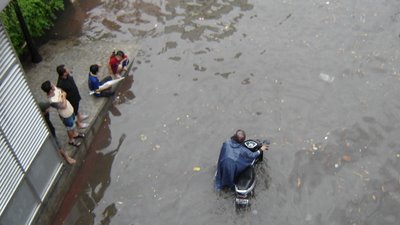
Tuesday we went to Singapore to renew our visas. We had a few hours to kill before getting on the plane, so I figured we should go hang out at a wi-fi cafe we'd heard about. This was a thoroughtly brilliant plan, except for two small details: 1) their internet connection wasn't working and 2) we got caught in a flash flood.

I didn't think much about the rain when it started. There's sometimes a period of heavy rain in the afternoon, but it always ends quickly. Except this time. It poured. And poured. And poured. Pretty soon I abandoned my magazine and joined the crowd staring from the balcony of the second-floor cafe at the scene down on the street. Taxis were driving in water as high as their hoods. A food vendor went past, pushing an almost totally-immersed cart. (I made a quick mental note to lay off the food carts for a few days.) Kids started swimming in the street. Adults who wanted to get anywhere had to take their shoes off, roll up their pants and wade.

Even tap water here is full of icky stuff. I don't want to think about what's in the gutter water. I just watched in amazement.

Finally it stopped raining and the waters began to recede. We carefully walked down the street and hailed a cab. The driver got out, shaking his head and laughing.

"Banjir," I said, which means "flood." Stating the obvious in a jovial tone - that's as close as I can get to a witticism right now in Indonesian.

We set out and immediately became embroiled in a full-blown Jakarta traffic jam. It was block after block of gridlock, with motorcycles weaving in and out, bajajs trying to squeeze through, and everybody honking at each other.

"Banjir macet," (bahn-jeer mah-chet) the driver laughed. "Flood traffic." And so it was - flood traffic all the way to the toll road, turning a 1-hour drive into more than two.

And Singapore? Well that's a whole other story - and a blog entry for later.

Friday, April 07, 2006

Leper nation


Tuesday we visited a leprosy hospital, the biggest, and one of the last, in Indonesia. Twenty years ago they had 500 patients here; now they have 100, and the staff actually outnumber the patients.

Still, even though leprosy (aka Hansen’s disease) is now curable, it keeps claiming new victims. We met one 21 year old guy whose right leg was paralyzed, who will walk with a lurching gait for the rest of his life. We met a 30-year old who has a wife and three kids, who used to sell noodles on the street for a living. The idea of trying to support a family on that income is mind-boggling in the first place, but now it’s very unlikely he’ll be able to do even that job. Nobody wants to buy food from a leper.

The doctor told us some of the patients use makeup, fake bandages, etc. to make their condition look worse. That way they can make more money begging in the street.

It wasn’t a completely unhappy visit, though. We met a very lively 65-year old woman who’s been living in a little compound at the hospital for eight years. She loves it. “I have food to eat, and lots of friends, and a TV, and doctors and nurses,” she said. “It’s like a leper nation here.” Her voice was so expressive, I almost felt like I could put her on the air without a translation.

The story is for a show called the World Vision Report. I’ll try to post a link when it’s done. It’s strange doing stories with tape in a foreign language. Feeling like you’re in control of your tape is a big issue for a radio reporter. I remember when I started, years ago, I often felt like the tape was pushing me around – taking the story in different directions than I wanted it to go. When I got more experienced I figured out how to turn the tables on it and make it work for me. Now the tape and I literally don’t speak the same language. I feel like I’m trying to build a house with jello – I can’t really get my hands around it. I’m meeting with the interpreter soon to get more precise translations of the cuts I’m using, and hopefully that will help dispel this uneasy feeling.

Sunday, April 02, 2006

movies


After experiencing movie theatres in the USSR, where the seats were always made of hard wood and your rear end was numb by the third hour of the movie (they all seemed to last three hours), I am a little suspicious of foreign theatres. But the ones in Jakarta are fabulous. The seats are plushy and comfortable and they're made for people my size (the seats in the US always seem to be designed for people who are 7 feet tall). You can get hot dogs with melted cheese and a generous smear of delicious hot chili paste, and french fries delivered hot to your seat. The seating is assigned, so you don't have to stake out your territory and guard it like a dog.

All this for only $2 to $2.50 a ticket! Except at really fancy malls, where it's more like $5 or $6.

There's censorship here, of course, and that's the downside. We went to see Brokeback Mountain, which I had seen in the States, and I found the editing choices puzzling. They seemed to leave in most or all of the gay scenes, including the first, pivotal one. But they cut out part of a scene between Heath Ledger and his wife. Chad's theory is it's all about protecting women, which seems to make sense. In which case I would say, hey guys, don't cut anything, I can handle it, no problem. I imagine the actress involved would say the same thing. But as so often happens, those who are being protected are not consulted about the terms of their protection.

The photo above is a still from the making of Janji Joni, a movie about the love of movies, by a cool director named Joko Anwar. You can link to his blog on the right side of my page.

Messages


Expat life in Jakarta is focused on text-messaging. SMSing is a lot cheaper than making a phone call, so if you’re going to a bar or a movie, or you want to find out if anyone else is going to a bar or a movie, you whip out the cellphone (or “handphone” as they’re called here) and start tapping.

Last night we went to see a new Indonesian movie called “Berbagi Suami,” or “Sharing Husbands.” The photo here is a scene from the movie. It was playing with English subtitles at a particularly glittery mall on the south end of town. Chad went to get a bite to eat at the food court. (I had gotten a bowl of beef, rice and vegetables at a Japanese fast food place for about $2 – very tasty.) I was waiting in front of the theatre with our new friend Angie, and it was getting closer and closer to 7:30. I sent him a message. No response. I was starting to write a second one when Angie said, “Why don’t you call?”

I stared at my handphone in confusion. I had forgotten it was a phone. “Wow,” I thought, “what value. What versatility. I can actually make calls on this thing.” Just then Chad showed up, saving me a few hundred rupiahs.

The movie was excellent, by the way. We’re going to try and find out whether it’s ever scheduled to play in the States, because we’d like to write about it. It’s about polygamy, which is apparently more common here than I realized. It’s also a great slice-of-life movie about the various social strata of Jakarta. It’s by one of a band of young Indonesian filmmakers trying to revive the film industry after it essentially died out under Suharto. Definitely worth a look if it ever plays near you.